
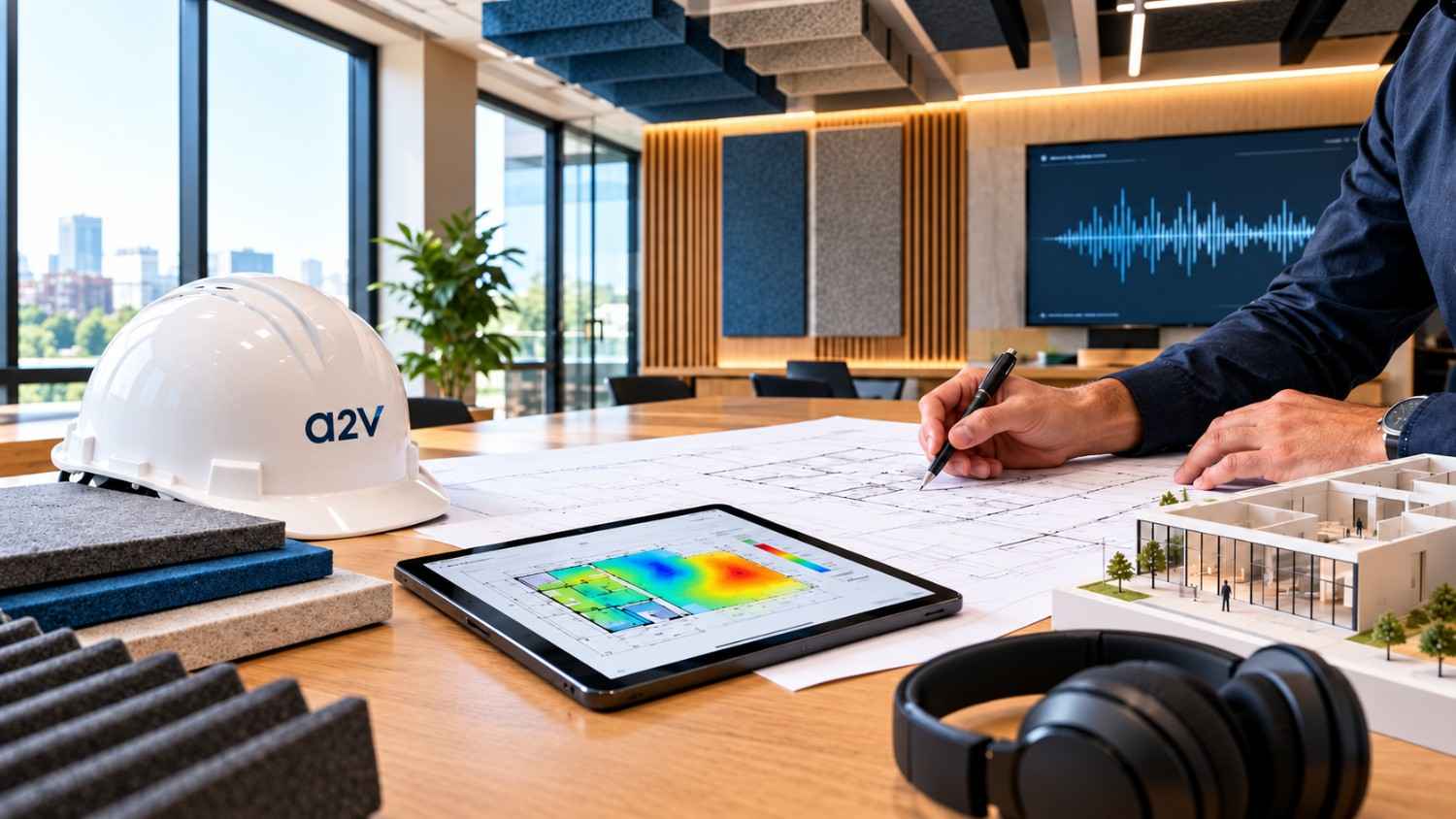
A building can look perfect on paper and still fail acoustically once people start using it.
Meeting rooms become echo chambers, office conversations travel through partitions, HVAC equipment creates persistent background noise, and residents discover that traffic sounds are louder indoors than expected.
These problems often have one thing in common: acoustic performance was considered too late in the design process.
Hiring an acoustic consultant before key building decisions are finalized allows architects, developers and project managers to address sound at its source.
The right time to engage acoustic consulting services is usually during the early planning or concept design stage. However, specialist advice can also be valuable during construction, renovation, commissioning and the investigation of existing noise problems.
Understanding when to involve an acoustic consultant helps project teams manage risk, improve building usability and make better-informed design decisions.
Why Acoustic Planning Should Begin Before Construction
Acoustics influence more than how a room sounds. They affect speech privacy, concentration, communication, occupant comfort and the way different spaces function together.
Consider a commercial office with glass meeting rooms beside open workstations. If sound isolation is overlooked, confidential conversations may be audible outside meeting rooms.
Adding absorptive panels might reduce echo inside those rooms, but it will not necessarily prevent speech from passing through inadequately isolated walls or doors.
Similarly, a restaurant may look attractive with concrete ceilings and hard flooring, yet excessive sound reflections can make conversations difficult when the space fills with customers.
These are design problems, not simply product-selection problems.
For architects and developers, the practical lesson is straightforward: acoustic performance should be coordinated with architecture, interiors, structural design and building acoustic consulting services from the beginning.
1. Hire an Acoustic Consultant During the Concept Design Stage
The concept design stage is generally the best time to involve an acoustic consultant.
At this point, the project team can still influence room arrangements, building orientation, partition locations, facade design and the relationship between noisy and quiet areas.
An acoustic consultant can help establish performance objectives before detailed specifications are prepared.
Depending on the project, early assessments may consider:
- Existing environmental noise from roads, railways, nearby businesses or industrial facilities.
- The location of noise-sensitive spaces such as bedrooms, offices, consultation rooms and classrooms.
- Separation between public, private and service areas.
- Initial requirements for sound insulation and room acoustics.
- Potential noise from lifts, generators, pumps, air-conditioning equipment and ventilation systems.
- The relationship between room geometry, finishes and acoustic performance.
For example, a developer planning a mixed-use building may need to consider how restaurants, retail spaces, residential apartments and mechanical plant interact acoustically.
Addressing these relationships during planning can give the design team more options than attempting to isolate every problem after construction.
Early acoustic input also helps define measurable objectives, allowing later design decisions to be assessed against an agreed brief.
2. When the Building Is Near a Noise Source
Some sites present acoustic challenges before the building design even begins.
Traffic, railway lines, airports, industrial facilities, construction activity and neighbouring commercial premises can all influence indoor noise conditions.
In these situations, an acoustic consultant can assess the existing environment and advise how the building should respond.
Potential recommendations may involve:
- Adjusting building orientation or room placement.
- Reviewing facade and glazing performance.
- Considering ventilation strategies that maintain acoustic comfort.
- Improving the sound isolation of walls, roofs, doors and windows.
- Assessing vibration transmission where relevant.
- Positioning noise-sensitive rooms away from significant sources where practical.
The correct solution depends on the frequency, intensity and character of the noise, along with the building’s intended use.
For instance, specifying thicker glass without assessing the full facade may not resolve the problem. Flanking paths, ventilation openings, junctions and other weak points can influence the overall result.
A site noise assessment helps the project team understand these variables before committing to a building envelope.
3. Before Designing Meeting Rooms, Auditoriums and Presentation Spaces
Spaces designed for communication need more than adequate dimensions and attractive finishes. Their acoustic requirements depend on how people will use them.
A boardroom requires clear speech and suitable sound isolation. An auditorium may need consistent speech intelligibility across the seating area. A training facility must support both the presenter and the audience, while a multipurpose hall may need to accommodate speech, presentations and musical performances.
An acoustic consultant can help determine the appropriate balance between reverberation, absorption, sound distribution and isolation.
This becomes particularly important when AV equipment is part of the design.
Microphones, loudspeakers, displays and conferencing systems cannot compensate for every acoustic weakness. Excessive reverberation can reduce speech clarity, while poorly controlled loudspeaker coverage can create uneven listening conditions.
Coordinating acoustic design with AV system design helps ensure that the room and its technology work together.
These decisions should be developed as one coordinated solution rather than separate installations.
4. When Planning an Office Fit-Out or Workplace Renovation
An existing office does not always need a complete acoustic redesign. However, a change in layout or occupancy can introduce problems that were not present before.
Common triggers include:
- Converting private offices into open-plan workspaces.
- Introducing more meeting rooms or phone booths.
- Creating hybrid collaboration areas.
- Removing partitions.
- Replacing suspended ceilings with exposed services.
- Increasing occupancy density.
- Relocating noisy equipment or shared facilities.
These changes can affect sound transmission, reverberation and background noise.
An acoustic assessment can identify whether the problem relates to excessive reflections, inadequate sound isolation, mechanical noise or poor spatial planning.
The distinction matters because each issue requires a different response.
Acoustic panels may help control reflections. Better partition construction may be necessary to improve isolation. Mechanical noise may require changes to equipment, ductwork, vibration isolation or system operation.
Professional assessment prevents businesses from spending money on treatments that address the wrong problem.
5. When Regulatory Requirements or Project Specifications Demand It
Some building projects have defined acoustic performance criteria, planning conditions or certification objectives.
Schools, healthcare facilities, residential developments, hospitality projects and mixed-use buildings may have particular requirements depending on their location, occupancy and intended use.
An acoustic consultant can help the design team identify applicable requirements, assess the proposed design and prepare the necessary technical documentation.
Depending on the brief, this may involve environmental noise assessments, sound insulation calculations, room acoustic modelling, equipment noise evaluations or verification testing.
The specific requirements vary by jurisdiction and building type. Not every project needs every assessment, so the scope should be established against the applicable regulations and project objectives.
Where acoustic performance must be demonstrated, it is important to clarify the required evidence early. Discovering a testing or documentation requirement near project completion can create avoidable delays.
6. Before Finalizing HVAC and Building Services
Mechanical systems are a frequent source of unwanted building noise and vibration.
Air-handling units, fans, pumps, chillers, generators and other equipment can transmit sound through the air or through the building structure.
If equipment selection and service routes are finalized without considering acoustic performance, the project may face restrictions later.
An acoustic consultant can coordinate with mechanical and electrical engineers to assess issues such as:
- Equipment noise levels and operating conditions.
- Vibration isolation requirements.
- Noise transmission through ducts and service openings.
- Plant-room location and separation.
- Background noise limits in occupied spaces.
- The potential effect of mechanical systems on speech communication.
This is particularly relevant to offices, hotels, healthcare buildings and other environments where background noise can affect comfort or communication.
The aim is not simply to make mechanical equipment quieter. It is to ensure that its noise and vibration are compatible with the function of the surrounding spaces.
7. During Construction, Before Problems Become Hidden
Although early engagement is preferable, acoustic consultancy can still be important once construction begins.
Some acoustic failures arise because the installed construction differs from the design intent. Gaps above partitions, poorly sealed penetrations, incorrectly installed doors and unsuitable material substitutions can all affect performance.
A consultant involved during construction may review technical submittals, assess proposed substitutions, inspect critical details and advise the project team when acoustic requirements need clarification.
This is particularly valuable before concealed work is covered by ceilings, wall linings or floor finishes.
Construction-stage involvement should be defined in the project scope. A design report alone does not automatically mean that the installed work will be inspected or tested.
Where performance is critical, the project team should identify which details require inspection and when those inspections need to occur.
8. Before Handover, When Performance Needs Verification
A completed building may require acoustic testing to establish whether the installed construction meets specified performance objectives.
Depending on the building and project brief, this can include sound insulation testing between rooms, background noise measurements, reverberation measurements or assessments of noise from building services.
Verification can be particularly useful when:
- The project specification includes measurable acoustic targets.
- A planning condition requires evidence of performance.
- Rooms will be used for confidential discussions or specialized communication.
- Noise complaints arise during commissioning.
- The client needs documented confirmation of the installed system’s performance.
Testing should be planned before completion, not treated as an emergency response after occupancy.
If a test identifies a problem, the consultant can help investigate its likely cause and recommend corrective measures. The appropriate remedy will depend on the results and the construction details.
9. When an Existing Building Has Persistent Noise Problems
An acoustic consultant is also valuable when a building is already occupied, and users report recurring issues.
Examples include meeting rooms with excessive echo, noise transfer between offices, vibration from plant equipment, poor speech privacy or external noise entering occupied spaces.
The first step is to identify the source and transmission path rather than immediately purchasing acoustic products.
A consultant may use site observations, sound measurements, construction reviews and technical analysis to establish the likely cause.
The investigation should distinguish between three common problems:
- Room acoustics: Sound reflections within a room make speech unclear or the environment uncomfortable.
- Sound insulation: Sound travels between rooms or from outside the building.
- Noise and vibration control: Mechanical equipment, building services, or other sources generate unwanted sound or vibration.
These problems can overlap, but they are not interchangeable. A targeted investigation helps determine which corrective measures are likely to be effective.
What Do Acoustic Consulting Services Typically Include?
The scope depends on the project, the building type and the performance objectives.
A small office refurbishment may need a focused assessment, while a complex commercial development may require acoustic input throughout the design and construction process.
| Project stage | Potential acoustic input |
| Feasibility and concept design | Site noise review, risk identification and initial acoustic strategy |
| Design development | Room acoustic criteria, sound isolation strategy and coordination with building services |
| Technical design | Specifications, construction details and review of proposed materials |
| Construction | Technical submittal review, inspections and advice on design changes |
| Commissioning and handover | Acoustic measurements, testing and performance verification |
| Existing-building assessment | Noise investigation, diagnosis and recommendations for improvement |
These activities should be agreed in advance. The appointment should specify deliverables, exclusions, site visits, testing responsibilities and the level of support required during construction.
How to Know Whether Your Project Needs an Acoustic Consultant
Not every project requires the same level of specialist involvement. The decision should reflect the consequences of getting the acoustics wrong.
An acoustic consultant is particularly worth considering when the project involves several interacting noise sources, sensitive occupants, demanding communication requirements, regulatory obligations or construction decisions that will be difficult to reverse.
A straightforward interior update may need only limited advice. A hospital, school, auditorium, hotel, mixed-use development or high-performance workplace may require a more detailed strategy.
Ask these questions before proceeding:
- Will people need to communicate clearly or maintain speech privacy?
- Is the site exposed to traffic, industrial noise or other external sources?
- Are quiet and noisy activities located close together?
- Could mechanical equipment affect occupied spaces?
- Are acoustic targets or compliance requirements specified?
- Would correcting a problem after completion require significant rework?
If several answers are yes, acoustic input should be considered before the design is finalized.
FAQs
What is the best time to hire an acoustic consultant?
The concept design or early planning stage is usually the best time. The consultant can influence layouts, materials, building services and performance criteria before key decisions become difficult to change.
Are acoustic consultants only needed for large projects?
No. Smaller projects may also benefit when they involve noise-sensitive rooms, sound isolation problems, hybrid meeting spaces or persistent noise complaints. The appropriate scope depends on the project’s complexity and risk.
Can an acoustic consultant help reduce construction costs?
Early advice can help identify acoustic risks before they require disruptive remedial work. However, the financial benefit depends on the project, the problems identified, and the solutions adopted. Cost savings should not be assumed without considering the specific circumstances.
What is the difference between acoustic treatment and soundproofing?
Acoustic treatment generally improves how sound behaves within a room by reducing reflections. Soundproofing is a broad term commonly used for measures intended to reduce sound transmission between spaces or from external sources. The required construction and treatment depend on the actual problem.
Should acoustic design be coordinated with AV design?
Yes, particularly in meeting rooms, auditoriums, training facilities and collaboration spaces. Room acoustics influence microphone performance, speech intelligibility and loudspeaker coverage. Coordinated design helps avoid treating the room and its AV system as unrelated elements.
Can acoustic problems be fixed after construction?
Many can be improved, but the available options depend on the cause. Some problems can be addressed through targeted treatment or equipment adjustments, while others may require changes to partitions, doors, ceilings or building services. Assessment should precede product selection.
Plan Better Acoustic Performance with a2v
The best time to address a building’s acoustic performance is before the decisions that determine it have been locked in. Early planning gives architects, developers and project managers greater control over room layouts, materials, sound isolation and building-services coordination.
At a2v, acoustic considerations form part of a wider approach to building performance, AV integration and user experience.
For commercial spaces, meeting environments, presentation facilities and other projects where sound quality matters, a2v can help teams consider acoustic requirements alongside the technology and design of the space.
Our acoustic consulting services support a more informed approach to planning, helping businesses and project teams identify acoustic priorities before they become difficult or costly to address.
If you are planning a new building, refurbishing an existing space or investigating persistent noise issues, start with an assessment of what the environment needs to achieve acoustically.