In today’s business world, audio and visual technology is a core component of daily operations, collaboration, and customer engagement. Whether you are equipping a boardroom, training center, retail space, or auditorium, the technology you choose can significantly impact productivity and user experience.
Businesses often debate whether to install a commercial AV solution or stick with a standard audio/video setup. While both involve speakers, displays, and projectors, the differences go far beyond the equipment itself.
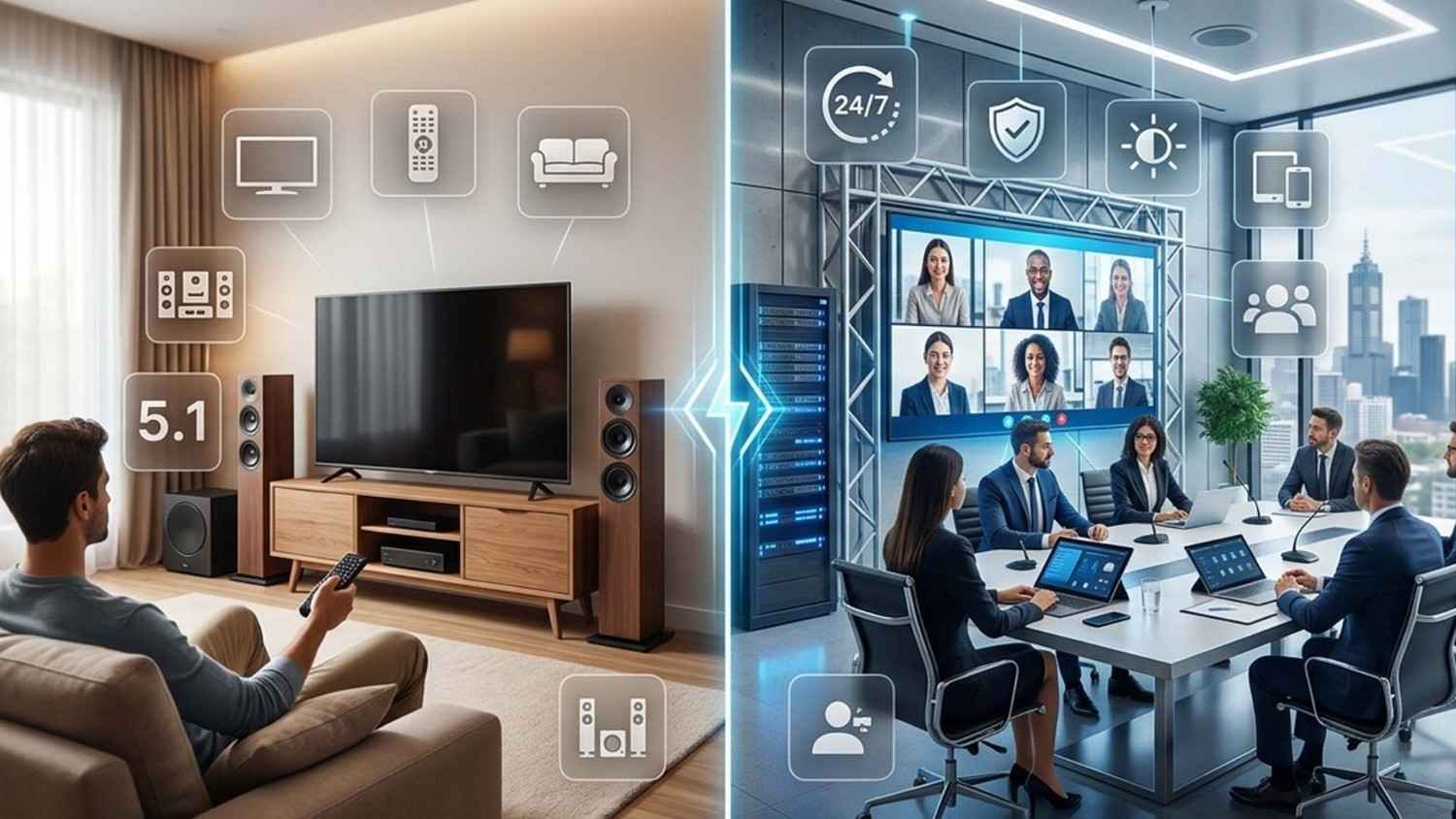
Commercial AV solutions are designed with professional-grade performance, scalability, and integration in mind, while standard setups are typically consumer-grade systems intended for home or small-scale use.
Understanding these distinctions is crucial for businesses seeking reliable, high-performing AV infrastructure.
What Are Commercial AV Solutions?
Commercial AV solutions refer to tailored audio-visual systems designed for professional, commercial, and enterprise environments. These solutions are built to handle higher demands, complex integrations, and a wide range of applications.
Key characteristics include:
- Professional-Grade Equipment: Speakers, microphones, projectors, displays, and control systems designed for continuous use and high performance.
- Integration Capabilities: Ability to connect multiple rooms, control systems, and devices through a unified platform.
- Scalability: Systems that can grow with the organization, including multi-room video conferencing, digital signage networks, and collaboration tools.
- Custom Solutions: Tailored to the specific needs of the business, including brand-specific signage, acoustics adjustments, and specialized hardware.
Commercial AV solutions are commonly used in:
- Corporate boardrooms and training centers
- Hotels, conference halls, and event spaces
- Retail environments with digital signage
- Educational institutions and auditoriums
What Is a Standard Audio/Video Setup?
A standard audio/video setup is typically a simpler, consumer-oriented system. These setups focus primarily on delivering basic audio playback and video display, without the need for integration or professional-grade performance.
Characteristics include:
- Consumer-Grade Equipment: Home theater speakers, off-the-shelf projectors, and TVs.
- Limited Integration: Devices function independently, with minimal interconnection.
- Restricted Scalability: Expanding the system often requires significant effort and may not be seamless.
- Basic Functionality: Designed for personal or small group use, lacking advanced features such as centralized control or professional sound calibration.
Standard setups are suitable for:
- Small office meeting rooms
- Home offices or entertainment areas
- Basic presentation needs without complex audio or video requirements
Key Differences Between Commercial AV Solutions and Standard Setups
- Performance and Reliability
Commercial AV solutions are built to deliver consistent, high-quality performance. They are designed for extended use and heavy-duty applications. In contrast, standard setups may struggle with large spaces or continuous use, leading to inconsistent audio or visual quality.
For example, commercial-grade speakers provide clear sound in large rooms without distortion, while consumer-grade speakers are typically optimized for smaller, controlled environments.
Similarly, professional displays and projectors in commercial settings offer higher brightness, better color accuracy, and longer lifespans than standard models.
- Integration and Control
A defining feature of commercial AV solutions is centralized control. Businesses can manage multiple devices, lighting, sound, displays, and conferencing tools from a single interface. This ensures smooth operation, quick troubleshooting, and ease of use for staff.
Standard setups usually lack such integration, requiring manual operation of individual devices. In complex environments such as conference centers or auditoriums, this limitation can lead to inefficiencies and errors.
- Scalability
Commercial AV systems are designed to scale. Companies can expand their display network, add video conferencing rooms, or integrate additional functionality as business needs evolve.
Standard setups are typically static. Adding new rooms or features often requires new equipment, additional wiring, and significant reconfiguration.
For businesses planning growth, commercial AV solutions provide a more cost-effective, long-term approach.
- Customization and Design
Commercial AV consultants tailor systems to specific spaces and business needs. This includes acoustic treatments, cable management, lighting integration, and ergonomic device placement. The result is a system optimized for the environment and user experience.
Standard setups are “off-the-shelf” and offer limited customization options. While suitable for simple use, they may not perform optimally in complex or large-scale environments.
- Advanced Features
Commercial AV solutions often include advanced functionalities, such as:
- Digital signage networks for customer communication
- Video walls with high-resolution displays
- Networked audio systems with zoned control
- Integrated video conferencing platforms with multi-room support
- Automated content scheduling and device management
Standard setups generally focus on the basics: audio playback, video display, and sometimes basic connectivity. They lack the features needed for modern business applications.
- Support and Maintenance
Commercial AV solutions include professional support, service contracts, and regular maintenance. This ensures minimal downtime and ongoing system optimization.
Consumer-grade systems rely on manufacturer warranties or third-party services, which may not provide the rapid response or tailored support needed for business-critical applications.
When Businesses Should Choose Commercial AV Solutions
- Corporate Offices and Boardrooms
Businesses that conduct regular meetings, presentations, and video conferences benefit from integrated systems that deliver reliable audio, clear visuals, and user-friendly controls.
- Event Venues and Hospitality
Hotels, conference centers, and event spaces require flexible AV setups that can accommodate multiple events, large audiences, and high-performance requirements.
- Retail and Showrooms
Commercial AV solutions enable dynamic digital signage, interactive displays, and immersive presentations that enhance customer experience and brand engagement.
- Educational Institutions
Lecture halls, auditoriums, and training centers need high-quality sound, large displays, and integrated systems that support multimedia teaching and hybrid learning environments.
Cost Considerations
While commercial AV solutions involve a higher initial investment than standard setups, they offer long-term savings through:
- Reduced downtime and maintenance costs
- Scalability that avoids frequent system replacements
- Enhanced operational efficiency and productivity
- Improved guest or customer experience, which can indirectly increase revenue
In contrast, standard setups may appear more affordable upfront but can incur hidden costs when scaling, upgrading, or troubleshooting performance issues.
Upgrade to Smarter, Scalable AV Systems
Choosing between a standard audio/video setup and a commercial AV solution is about understanding business needs, scale, and future growth. While standard setups can handle basic tasks, commercial solutions offer professional-grade performance, integration, scalability, and advanced features designed for modern business environments.
At a2v Consulting, we specialize in designing and implementing custom commercial AV solutions tailored to your specific business requirements. Our expertise ensures that your AV systems are reliable, scalable, and optimized for collaboration, events, and client engagement, helping your organization operate efficiently while delivering a seamless audiovisual experience.
Contact A2V Consulting Group today to discover tailored commercial AV solutions that deliver performance and reliability.
FAQs
Can a standard AV setup work for small businesses?
Yes, for basic meetings or small conference rooms, a consumer-grade setup may suffice. However, it won’t scale well for multiple rooms or complex events.
What makes commercial AV solutions more reliable?
They use professional-grade equipment, integrated control systems, and expert installation to ensure consistent performance even in large or demanding environments.
Are commercial AV solutions customizable?
Absolutely. They can be tailored to room size, usage requirements, acoustic conditions, and brand identity.
Do commercial AV solutions require professional installation?
Yes. Proper design and setup are crucial to ensure system performance, integration, and long-term reliability.
How do commercial AV solutions support hybrid meetings?
Commercial AV solutions integrate video conferencing, high-quality audio, multiple displays, and centralized control, providing seamless experiences for both in-person and remote attendees.